Messenger


Running Google Ads: An Effective Approach to Optimize Costs and Increase Conversions
Running Google Ads is no longer just about “turning ads on and spending money.” As costs continue to rise and competition intensifies, the effectiveness of advertising depends heavily on the approach, campaign structure, and the ability to optimize throughout the process. A well-crafted strategy from the beginning helps businesses reach the right audience, control budgets more effectively, and improve the quality of conversions.
Where should you start with Google Ads?
Before thinking about choosing campaign types or writing ad copy, the most important step in running Google Ads is defining your business’s true objective. This goal should go beyond clicks or impressions and be tied to specific actions such as form submissions, phone calls, purchases, or consultation sign-ups.
Once your objective is clearly defined, choosing the right campaign type (Search, Display, Performance Max, etc.) and measuring performance becomes much more consistent. On the other hand, if your goal is unclear, your campaign can easily fall into the trap of “getting traffic but no real results.”
Keyword Selection Mindset in Google Ads
One of the most common mistakes in running Google Ads is focusing too heavily on high-volume keywords. In reality, these keywords often come with high competition and costs, but do not necessarily deliver strong conversion rates.
Instead, prioritizing keyword groups with clear search intent (such as purchase intent, comparison, or contact inquiries) helps ads reach users who are ready to take action. Additionally, grouping keywords by theme and search intent allows for better control over ad messaging and landing page optimization.
Contact DYM VIETNAM here!
How does campaign structure affect advertising performance?
Campaign structure is a foundational factor, yet it is often overlooked. When running Google Ads with a structure that is either too scattered or too consolidated, it becomes difficult for the system to optimize and for advertisers to accurately evaluate the performance of each content group.
A clear structure, organized by services, products, or user intent groups, helps to:
- Better control budget allocation for each segment
- Optimize ad copy to closely match keywords
- Analyze and adjust performance more quickly
This is especially important when the budget is limited and needs to be focused on high-value segments.

Ad Copy and Landing Page Need to Be Aligned
When running Google Ads, ad copy is only the first step. The user experience after clicking is what ultimately determines conversions. If the ad content and the landing page are not aligned, bounce rates will increase and the cost per conversion will rise.
The landing page should focus on directly addressing the user’s search intent, clearly presenting benefits, key differentiators, and a specific call to action. Landing page optimization does not need to be overly complex, but it must ensure clarity and consistency with the ad message.
Tracking and Measuring Performance in Google Ads
You cannot optimize without measurement. When running Google Ads, setting up conversion tracking from the very beginning is essential. This allows you to accurately evaluate which campaigns are delivering results and which keywords are consuming budget without generating value.
In addition to basic metrics such as CTR and CPC, businesses should focus on performance indicators tied to business goals, such as the number of conversions, cost per conversion, and the quality of leads.
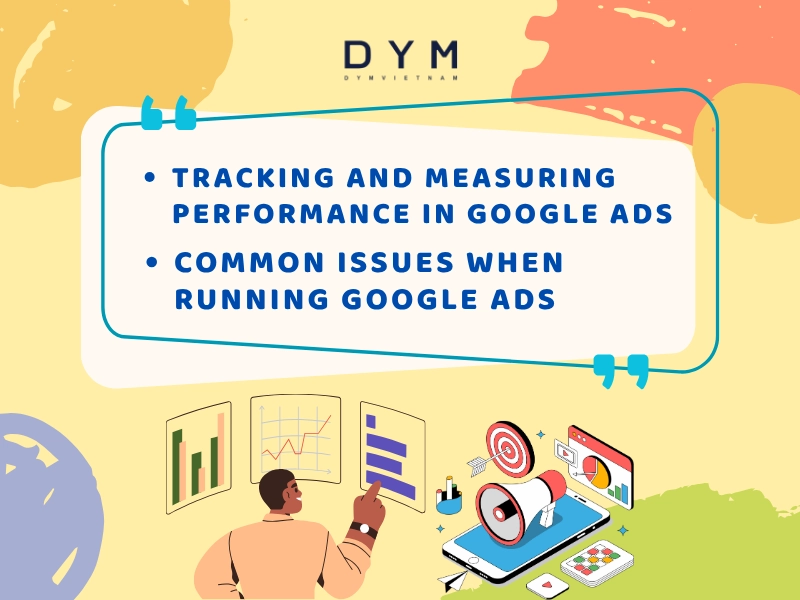
Common Issues When Running Google Ads
During campaign execution, many Google Ads campaigns experience rising costs without improved performance. This can be caused by overly broad keywords, underperforming ad copy, or landing pages that are not optimized for conversions.
In addition, failing to regularly review and exclude irrelevant search queries can lead to wasted budget and fragmented spending. Optimizing Google Ads should be an ongoing process based on real data rather than intuition.
Running Google Ads in a Sustainable Way
Instead of constantly changing the structure or running unfocused experiments, a sustainable Google Ads strategy should be based on data, strong budget control, and a focus on conversion quality. When campaigns are built correctly, Google Ads not only delivers short-term customers but also effectively supports a business’s long-term marketing efforts.
Google Ads Management Services by DYM Viet Nam
We provide Google Ads management services for Japanese businesses and local companies in Vietnam, with a focus on real conversion performance rather than simply increasing impressions or clicks.
Google Ads formats we can implement:
- Google Search Ads – Text ads that appear when users search for relevant keywords
- Google Display Network – Banner ads shown across Google partner websites and apps (including remarketing)
- YouTube Ads – Video ads displayed before, during, or after YouTube videos
- Google Shopping Ads – Product-based ads featuring images, prices, and purchase links (suitable for e-commerce)
- Remarketing – Reaching users who have previously visited your website through banners or video ads
- Local Ads – Location-based targeting to drive calls, bookings, or store visits
5 reasons to choose our Google Ads management service:
- Performance-driven campaign design focused on results
- Optimization tailored to the Vietnamese market
- Dedicated team with close, hands-on support
- Transparent reporting backed by measurable data
- Integrated creative and operational workflow
Conclusion
Effective Google Ads performance does not come from applying a fixed formula, but rather depends on understanding user behavior, building well-structured campaigns, and the ability to optimize at each stage. When there is a clear strategy, a proper structure, and accurate measurement, Google Ads can become a channel that delivers stable and long-term value for businesses.
DYM VIETNAM’s “Google Ads Management Agency Service” page here.


Table of content