Messenger


Understanding Facebook Advertising: How It Works, Costs, Measurement, and Optimization for Sustainable Conversion Growth
Facebook Ads is a channel that helps brands reach customers across the Meta ecosystem, including Facebook, Instagram, Messenger, and other placements. However, to run campaigns effectively, success doesn’t come from “tactical hacks” — it comes from choosing the right objective, measuring accurately, and optimizing based on data.
This article follows a flow from foundation to execution: you’ll understand how Facebook Ads delivery works, how to choose objectives based on business goals, how costs are calculated, what needs to be prepared for proper measurement, how to craft effective ad messaging, and the key policy considerations to ensure stable performance.
What Is Facebook Advertising and How Does It Work?
Facebook advertising is a paid method that allows your content (videos, images, posts, lead forms, etc.) to be delivered to a relevant audience based on the objective you select in Meta Ads Manager.
The key concept to understand: you are not “buying a fixed ad placement.” Instead, ads run through an auction-based system. This means the platform decides which ad gets delivered based on multiple factors, typically including:
- Your bid amount (related to CPM, CPC, CPA, etc.)
- Ad quality and relevance to the target audience
- The likelihood of generating the desired action (clicks, form submissions, purchases, etc.)
Therefore, simply increasing your budget does not guarantee better performance. If your creative, audience targeting, offer, or landing page is not optimized, costs may rise while conversions (CV) or conversion rate (CVR) fail to improve.
Where Do Facebook Ads Appear?
Depending on your campaign settings, Facebook ads can appear across multiple placements within the Meta ecosystem, including:
- Facebook Feed and Instagram Feed
- Stories and Reels
- Messenger
- Facebook Marketplace
- Audience Network (Meta’s partner apps and websites)
In practice, users most commonly encounter ads in the Feed, Reels, and Stories, especially on mobile devices.
Advertising Metrics to Track for Each Business Objective
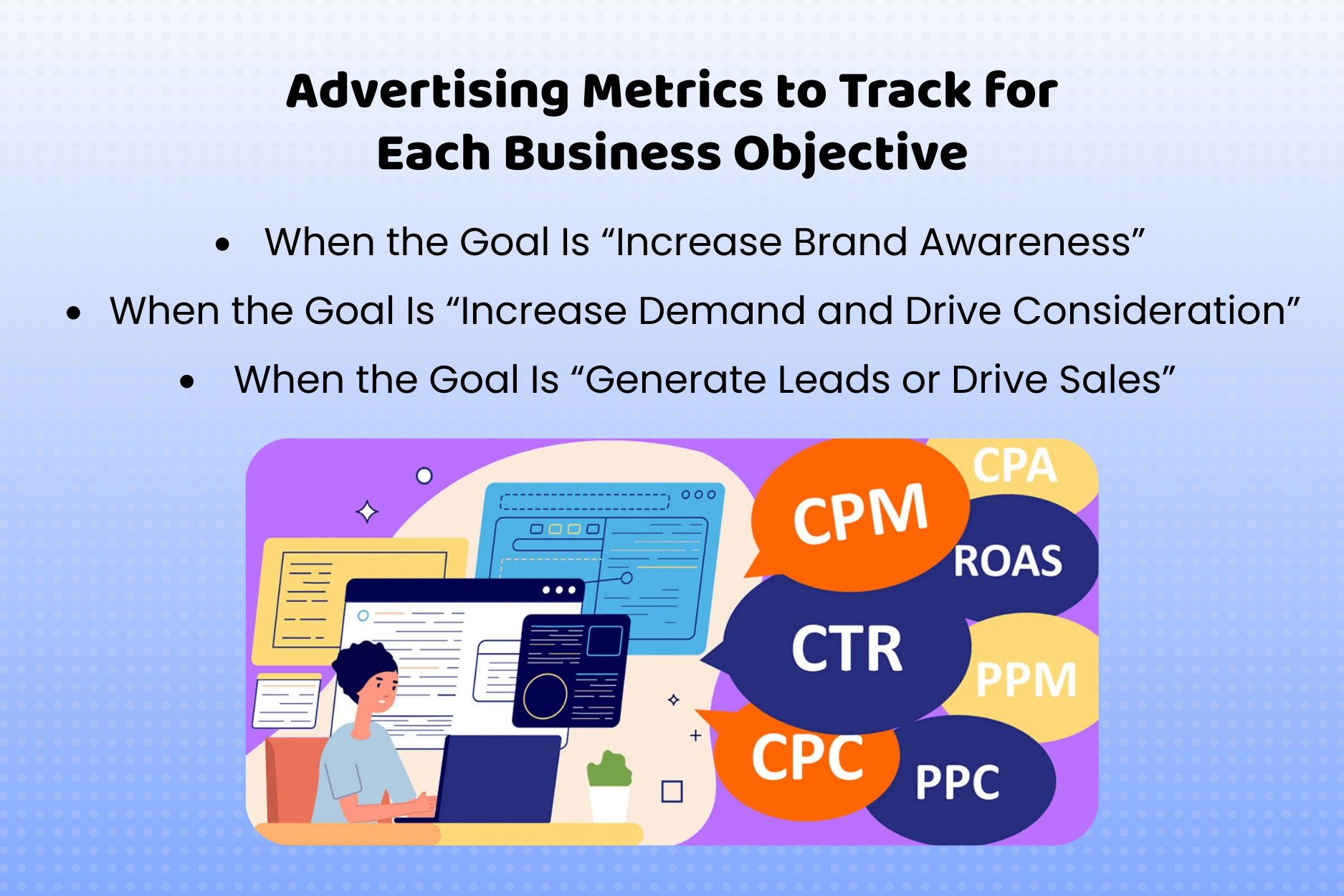
To achieve sustainable performance, you need to start with your business objective, and only then choose the appropriate advertising objective. Below is a simple and practical mapping approach:
When the Goal Is “Increase Brand Awareness”
- Common advertising objectives: Increase Brand Awareness/Reach or Video Views
- Key metrics to track: CPM, Reach, Frequency, Views, Watch Time
- Note: Campaigns in this category typically do not generate immediate sales. Their primary role is to expand the audience pool and lay the groundwork for later stages of the funnel.
When the Goal Is “Increase Demand and Drive Consideration”
- Common advertising objectives: Engagement, Video Views, or Traffic (if directing users to a website)
- Key metrics to track: CTR, CPC, engagement quality, watch time, return rate
- Note: If you drive traffic to a website with a weak landing page, you may see high click volume but little to no conversions.
When the Goal Is “Generate Leads or Drive Sales”
- Common advertising objectives: Messages, Lead Generation, or Conversions/Sales
- Key metrics to track: CPA/CPL, Conversions (CV), Conversion Rate (CVR), Lead Quality, ROAS (if revenue is tracked)
- Note: This objective group requires strict and accurate tracking. Without clear measurement, optimization becomes extremely difficult and inefficient.
Liên hệ DYM VIETNAM ngay! Contact DYM VIETNAM here!
How Is Facebook Advertising Cost Calculated?
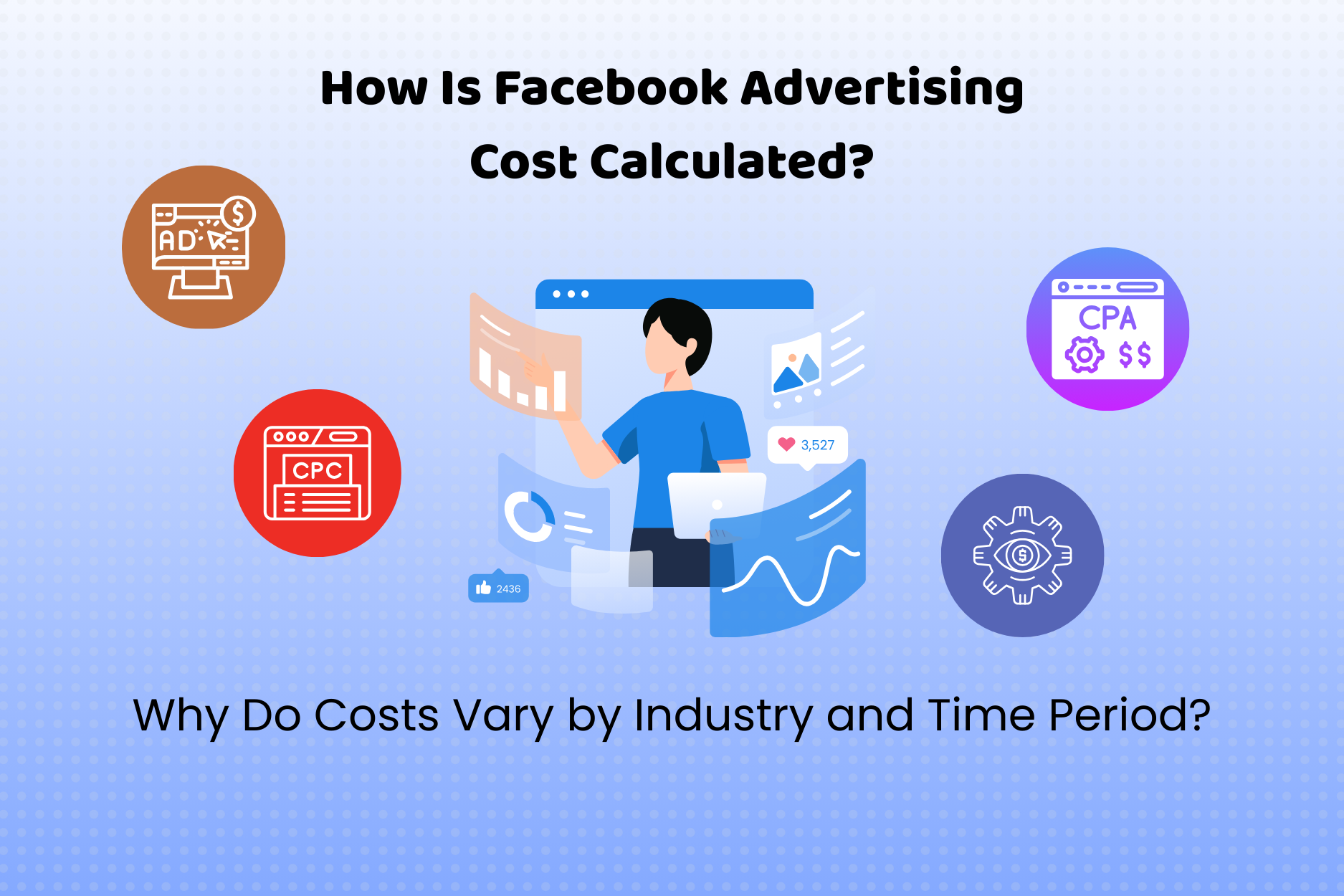
Facebook Ads does not have a fixed pricing table that applies to every industry. In reality, costs are determined based on the optimization objective you choose and the level of competition at the time your ads are running.
Common Pricing Models
- CPM (Cost per Mille): Cost per 1,000 impressions
- CPC (Cost per Click): Cost per click
- CPA / CPL (Cost per Acquisition / Cost per Lead): Cost per conversion or per lead
- ROAS (Return on Ad Spend): Revenue generated compared to advertising cost (commonly used for sales campaigns)
Key point to remember: CPM and CPC only reflect the “input” side of the process.The true performance outcomes are measured by CV, CVR, CPA, and ROAS.
Why Do Costs Vary by Industry and Time Period?
Several key factors directly influence Facebook Ads costs:
- Industry competition and seasonality (major promotions, year-end sales, holidays, etc.)
- Audience targeting: An audience that is too narrow can increase CPM due to limited reach.An audience that is too broad may generate many low-quality clicks.
- Ad creative quality: Unclear messaging → lower CTR → higher CPC.
- Ad placements: Reels, Stories, and Feed placements have different competition levels and pricing dynamics.
- Landing page and user experience: Slow loading speed or mismatched messaging → lower CVR → higher CPA.
Instead of asking, “What is a good CPC benchmark?”, a more practical question to ask is: “Based on my objective, is my current CPA or CPL reasonable — and where is the bottleneck in my funnel (CTR or CVR)?”
Facebook Ads Measurement Foundation: Accurate Tracking Makes Optimization Meaningful
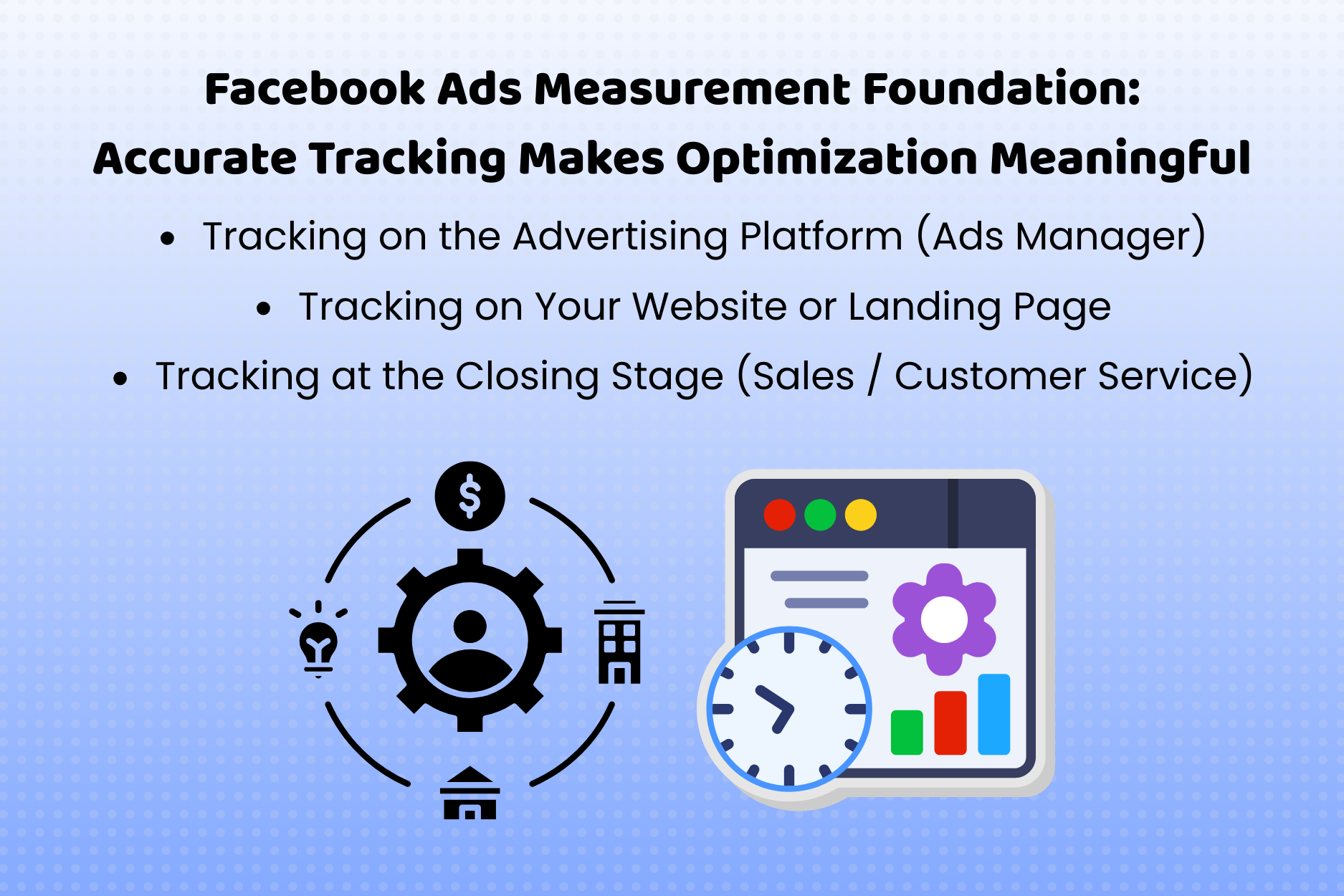
A campaign may look “good on the surface” but fail to generate real results if tracking is incomplete or inaccurate. In 2026, a solid measurement foundation typically revolves around three layers:
Tracking on the Advertising Platform (Ads Manager)
In Ads Manager, you will see metrics such as CPM, CTR, CPC, CV, CPA, and ROAS.This is where delivery optimization happens.
Tracking on Your Website or Landing Page
If you sell through a website or landing page, you should have:
- Meta Pixel to track user behavior (page views, add to cart, purchases, etc., depending on your business model)
- Conversions API (CAPI) if you need more stable data and want to reduce discrepancies caused by browsers or devices
- UTM parameters for cross-checking performance in GA4 (if your business uses a web analytics system)
There’s no need to overcomplicate it: Pixel and CAPI help you understand who did what, allowing the system to optimize toward the specific actions you care about.
Tracking at the Closing Stage (Sales / Customer Service)
If conversions happen via messages or phone calls, you still need a clear measurement framework, including:
- What qualifies as a valid lead
- Response rate
- Close rate
- A clear method for attributing leads to specific campaigns
Without this layer, you may run into situations like: “Ads report many leads, but sales say they’re low quality,” or“Sales are closing deals, but no one knows which campaign generated them.”
An Effective Facebook Ads Content Framework: Focus on Message, Not Tricks
Effective ad content doesn’t need to be flashy — but it must follow the right sequence: the right audience → the right problem → the right reason to believe → the right motivation to act.
Message Framework in 4 Groups (Easy to Apply)
- Problem-focused messages: Describe the situation or pain point your customers are currently experiencing.
- Solution-focused messages: Clearly explain how your product or service helps and what makes it different.
- Proof-based messages: Include reviews, customer experiences, internal data, guarantees, or process transparency.
- Offer / Motivation-driven messages: Provide incentives such as gifts, limited-time offers, bundles, or special policies.
You don’t need to include all four message types in a single ad. What matters most is that the message aligns with the stage your customer is currently in.
“Proof” That Builds Trust
Depending on the industry, proof can include:
- Customer testimonials, real case studies, or experience-based visuals
- Before–after comparisons (presented carefully and without exaggeration)
- Your working process or service standards
- Warranty/return policies and clearly stated terms and conditions
Align Your Ad Content with the Landing Page
A common mistake is when the ad communicates one message, but the landing page presents something different. In this case, CTR may look healthy, but CVR drops and CPA increases. The right approach is:
- The ad highlights the core benefit clearly and directly
- The landing page expands on the message and addresses remaining questions or objections
- The CTA is clear and aligned with the exact action you want users to take
Complying with Policies for Stable Performance
Within the Meta ecosystem, the biggest advertising risk is not just high costs — it’s disruption. Campaigns can be rejected, restricted, or even negatively impact your ad account.
Common Causes of Ad Issues:
- Sensitive content (wording, imagery, or exaggerated claims)
- Unclear landing pages or poor user experience
- Account/Page/payment history issues
- Sensitive industries (beauty, health, finance, etc.) that require stricter and more careful messaging
The sustainable approach is to write neutral, clear content, state conditions transparently, avoid absolute claims, and ensure the landing page is transparent.If an ad gets rejected, the right way to handle it is to review and adjust the content and information carefully — rather than trying to “work around” the system.
When Should You Run Facebook Ads Yourself and When Should You Hire an Agency?
Running Ads Yourself Is Suitable When:
- You have time to test and learn gradually
- Your objective is simple (e.g., generating basic messages or leads)
- Your budget is still modest and your growth expectations are moderate
You Should Consider Hiring Specialists When:
- You need a structured measurement setup (Pixel, CAPI, GA4, data reconciliation)
- You want to scale, but costs are rising and becoming difficult to control
- You frequently encounter policy issues
- You need to align advertising with content strategy, landing pages, and sales processes to improve CVR
The most important factor when working with an agency is not a promise of “guaranteed sales,” but a transparent way of working: clear objectives, clear measurement methods, clear reporting, and data-driven optimization rather than decisions based on intuition.
Frequently Asked Questions About Facebook Advertising
Is Facebook Advertising Suitable for Every Industry?
It works for many industries, but performance depends heavily on the product, offer, messaging, landing page, and sales process. Highly competitive industries often require greater investment in content quality and measurement setup to achieve effective optimization.
What Budget Is “Enough” to Run Ads?
There is no single number that applies to every situation. In practice, your budget needs to be sufficient to generate the minimum amount of data required to properly evaluate CTR, CVR, and CPA. If you spread the budget too thin or keep making constant changes, it becomes very difficult to draw accurate conclusions.
Why Do You Get Many Clicks but No Sales or Low-Quality Leads?
The issue usually lies in one of these areas: the message doesn’t match the target audience, the landing page is not persuasive, the offer is unclear, or the consultation/closing process is weak. In such cases, you need to review CVR and lead quality, not just CTR.
Do You Need Pixel/CAPI If You Only Run Message Campaigns?
It’s not mandatory. However, you still need a way to track lead sources and lead quality in order to optimize effectively.If you have a website and clear sales objectives, implementing Pixel/CAPI will help create more stable and sustainable optimization over time.
Comprehensive Advertising Services by DYM VN
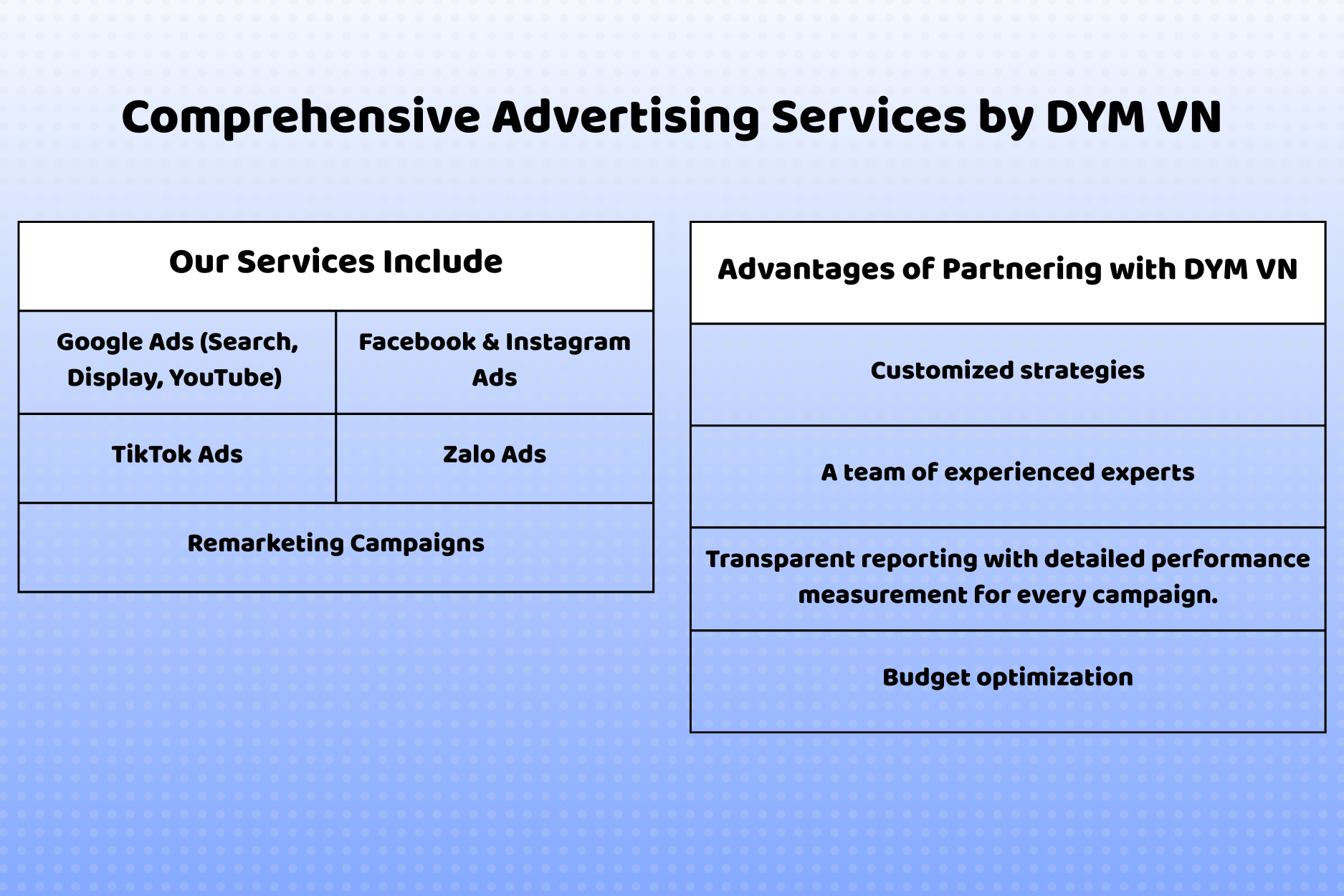
With over 10 years of experience in the Japanese and Vietnamese markets, DYM VN provides multi-platform advertising services through a professional, effective, and transparent process.
Our Services Include:
- Google Ads (Search, Display, YouTube) – Reach users with high purchase intent.
- Facebook & Instagram Ads – Build communities and increase brand engagement.
- TikTok Ads – Amplify creative content, especially among younger audiences.
- Zalo Ads – Connect with potential customers in the Vietnamese market.
- Remarketing Campaigns – Re-engage and convert existing prospects and past visitors.
Advantages of Partnering with DYM VN
- Customized strategies tailored to each business objective.
- A team of experienced experts in SEO, SEM, and Digital Advertising.
- Transparent reporting with detailed performance measurement for every campaign.
Budget optimization focused on delivering the highest possible ROI.
Conclusion
Running Facebook Ads effectively is not about simply setting up campaigns and pressing “launch.” It’s about truly understanding how delivery works, selecting objectives based on real business needs, controlling costs through the right metrics, building a clear measurement foundation, and operating in compliance to ensure long-term stability.When all these elements align, optimizing CV, CVR, and CPA — and scaling sustainably — becomes significantly easier.
DYM VIETNAM’s “Facebook Advertising Management Service” page here.


Mục Lục Table of content
- When the Goal Is “Increase Brand Awareness”
- When the Goal Is “Increase Demand and Drive Consideration”
- When the Goal Is “Generate Leads or Drive Sales”
- Tracking on the Advertising Platform (Ads Manager)
- Tracking on Your Website or Landing Page
- Tracking at the Closing Stage (Sales / Customer Service)
- Message Framework in 4 Groups (Easy to Apply)
- “Proof” That Builds Trust
- Align Your Ad Content with the Landing Page