Messenger


AI SEO Case Study: How to Build a Sustainable SEO Growth Strategy with Artificial Intelligence
In a context where Google increasingly prioritizes high-quality content, user search behavior is constantly changing, and AI is strongly impacting how information is created, AI SEO is no longer an experimental trend. It is becoming a practical SEO implementation method that helps businesses accelerate content production, accurately understand search demand, and optimize the effectiveness of the entire marketing system.
However, the most important thing to understand is: AI SEO is not just about using AI to write articles. If it stops there, businesses can easily fall into a situation where they produce a large volume of content that does not rank, generate traffic that does not convert, or worse, create a content system that lacks direction, depth, and revenue-generating capability.
This article is a practical case study that describes how a business can implement AI SEO as a long-term growth strategy, instead of treating AI as a short-term support tool.
Initial context: SEO is being done but not creating growth momentum
The business in this case operates in the service sector, has a website, and has been doing SEO content for a relatively long time, but the results are not proportional to the effort invested. Several issues are clearly visible:
First, content is produced consistently but lacks structure. Each article targets a separate keyword, without topic clusters that cover the entire customer search journey.
Second, the SEO team focuses too much on keyword volume without thoroughly analyzing search intent. This leads to content that ranks but does not match the actual needs of users.
Third, the content has technical SEO elements but lacks contextual depth. Articles answer surface-level questions but do not address concerns, comparisons, considerations, or decision-making stages of readers.
Fourth, the content production process relies heavily on manual effort, making it slow, difficult to scale, and hard to maintain consistency across the system.
This is a very common situation: businesses are doing SEO, but they do not yet have a data-driven, AI-powered SEO strategy.
Core problem: Not a lack of content, but a lack of system
When analyzing deeply, the key issue is not “how many more articles to write,” but:
- Who the content is for
- Which stage of the search journey it addresses
- What topics it should cover to build topical authority
- How content can be expanded, updated, and converted
In other words, the problem lies not in content volume but in content architecture.
Therefore, the AI SEO strategy here does not start with choosing writing tools, but with restructuring the entire SEO logic.
Liên hệ DYM VIETNAM ngay! Contact DYM VIETNAM here!
Strategic objectives
Before implementation, the team defined three clear goals.
The first goal is to grow organic traffic sustainably, rather than chasing short-term traffic from scattered articles.
The second goal is to increase the number of ranking keywords, especially long-tail, semantic, and intent-driven keywords.
The third goal is to improve content conversion quality, meaning users do not just visit and leave but go deeper into the website, explore services, and take meaningful actions.
The key point here is: SEO should not be viewed as merely a traffic channel, but as a system for generating demand and driving conversions.
How to implement AI SEO strategically
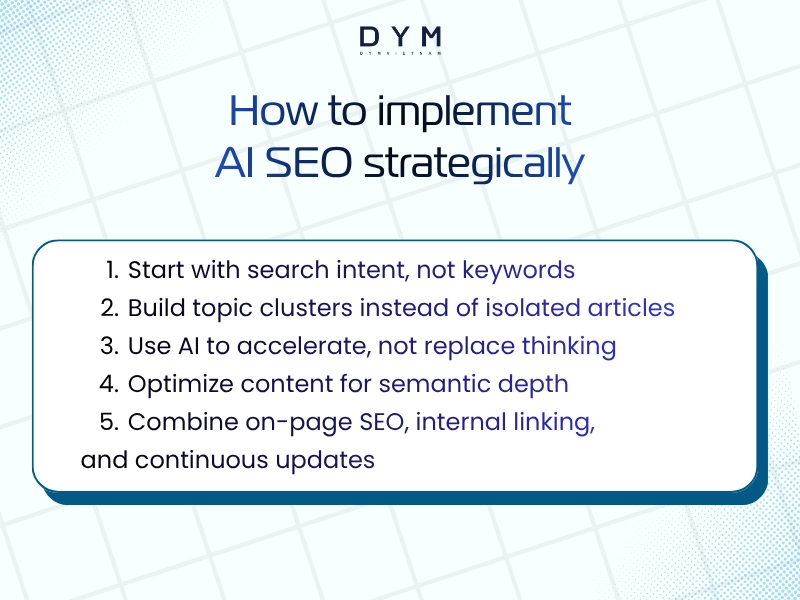
Start with search intent, not keywords
This is the most important step.
Instead of selecting keywords based on intuition or just volume, the system is analyzed through four intent layers:
- Informational: users are learning concepts
- Comparative: users are comparing solutions
- Consideration: users are evaluating how to implement
- Transactional: users are ready to find services or tools
AI is used to analyze search data, suggest content patterns, classify intent, and identify content gaps that competitors have not effectively addressed.
As a result, each article is no longer a standalone piece of content but becomes a touchpoint in the entire customer decision journey.
Build topic clusters instead of isolated articles
After mapping intent, the content strategy is organized into topic clusters.
For example, with the topic AI SEO, the system can be structured as:
- Pillar content: What is AI SEO?
- Supporting content: how to implement AI SEO, AI SEO tools, AI SEO vs traditional SEO
- Extended content: AI search, LLMO, optimizing content for AI, semantic SEO
- Conversion content: AI SEO services, SEO + ads solutions, practical implementation strategies
This approach brings two major benefits.
First, it helps Google understand that the website has real depth in a specific topic.
Second, it guides users through a natural flow, from learning to considering and ultimately taking action.
AI plays a supporting role in suggesting topic clusters, structuring content groups, and optimizing internal linking.
Use AI to accelerate, not replace thinking
This is a commonly misunderstood point.
In this case, AI is not used to automatically generate and publish large volumes of content. Instead, it is used as an acceleration system for each stage:
- Content ideation
- Intent-based outlining
- Suggesting semantically rich headings
- Identifying secondary keywords and entities
- Proposing different angles for each content type
Then humans handle editing, adding strategic insights, industry context, real experience, and appropriate CTAs.
In other words, AI saves production time, but humans still determine the final quality. This is what makes AI SEO effective.
Optimize content for semantic depth
One of the biggest weaknesses of traditional SEO content is keyword stuffing without building context.
With AI SEO, content must cover multiple semantic layers, including:
- Primary keywords
- Secondary keywords
- Related entities
- Frequently asked questions
- Application context
- Decision-making scenarios
For example, an article about AI SEO should not only define AI, but also answer:
- How AI supports SEO
- When to use AI
- When not to rely on AI
- Why AI-generated content still needs human editing
- How SEO is changing in the era of AI search
The more comprehensive the semantic coverage, the more likely the content will be correctly understood by Google and referenced by AI systems in aggregated responses.
Combine on-page SEO, internal linking, and continuous updates
AI SEO does not end at content publication. In fact, the post-publication phase is when the system starts learning.
Each article is tracked using metrics such as:
- impression
- CTR
- time on page
- bounce rate
- keyword movement
- internal click flow
Based on this data, AI helps identify which content is performing well, which needs updating, what keywords should be added, and which internal links should be strengthened.
As a result, SEO becomes a continuous optimization loop rather than a one-time task.
Strategic results
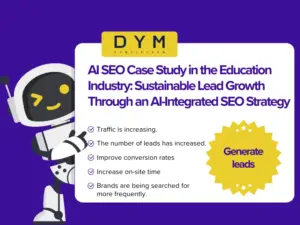
After a period of proper implementation, the system begins to show positive signals.
Traffic grows not just on individual articles but across entire topic clusters.
The number of indexed and ranking keywords gradually increases.
Users stay longer because the content guides them and addresses their real concerns.
More importantly, traffic quality improves, meaning users go deeper into the service exploration journey instead of just reading and leaving.
The most valuable aspect of AI SEO is not “faster content creation,” but building a scalable, structured, measurable system with clear growth direction.
Key strategic lessons
From this case study, several important lessons can be drawn.
First, AI does not replace strategy. Without a proper content system, AI only accelerates mistakes.
Second, modern SEO must be approached through topic clusters and search journeys, not isolated articles.
Third, good content is not just long or keyword-rich, but content that answers the right questions at the right time and context.
Fourth, humans remain the decisive factor in creating insights, emotions, and brand positioning.
Effective AI SEO implementation for businesses
In reality, many businesses understand AI SEO conceptually but struggle to turn it into an operational system. The reason is that AI SEO should not stand alone; it needs to be integrated with SEO, content, and advertising into a comprehensive strategy.
This is why partnering with an experienced multi-channel marketing agency can create a significant difference.
DYM Vietnam – Integrated Advertising and Marketing Solutions
With over 10 years of experience in the Japanese market, DYM Vietnam provides multi-platform advertising services with a professional, effective, and transparent process.
Services include Google Ads (Search, Display, YouTube), Facebook & Instagram Ads, TikTok Ads, Zalo Ads, and remarketing campaigns, helping businesses reach the right audience at each stage of the journey.
Key advantages of working with DYM Vietnam include personalized strategies tailored to each business goal, an experienced team in SEO, SEM, and digital advertising, and transparent reporting systems to clearly measure campaign performance. In addition, budget optimization helps improve ROI in a practical way.
This forms a strong foundation for businesses to not only optimize SEO but also fully leverage LLMO within an integrated marketing strategy.
Conclusion
AI SEO is not a shortcut for faster content creation. It is a method of building a growth system driven by data, structured content, and strategic thinking.
Businesses that apply AI correctly will not only save time but also build long-term competitive advantages in an increasingly evolving search environment.
In the context of AI search, LLMO, and continuously changing user behavior, AI SEO is no longer optional. It is becoming a necessary component of the marketing strategy for brands that aim for sustainable growth.
DYM VIETNAM’s “SEO Services” page here.


Mục Lục Table of content