Messenger


SEO Optimized Website Design: 5 Core Criteria and Quick Checks
Many businesses build visually appealing websites but still struggle with no organic traffic, consistently publishing content without ranking, or facing high CPC/CPA in ads due to slow-loading and low-trust landing pages.The issue often isn’t a “lack of content,” but rather that the website foundation is not SEO-friendly.
This article goes straight to the core: what SEO-optimized web design is, the 5 most important criteria groups, and how to quickly self-audit your website.
What is SEO-optimized website design?
SEO-optimized web design is the process of building a website in a way that helps Google easily crawl, index, and understand the content, while also ensuring a logical content structure and a good user experience to improve rankings and conversions.
A SEO-friendly website can be understood as having three layers:
- Technical: the website has a clear structure, no basic errors, and includes components such as sitemap.xml, robots.txt, proper handling of redirects (301), error pages (404), duplicate content management (canonical), and uses HTTPS/SSL.
- Content: each page has a clear purpose (service/product pages, about page, blog articles, etc.), and the content matches user search intent.
- User Experience: fast loading speed, mobile-friendly display (mobile-first), easy-to-read layout, and clear CTAs.
5 Core Criteria Groups of an SEO-Optimized Website
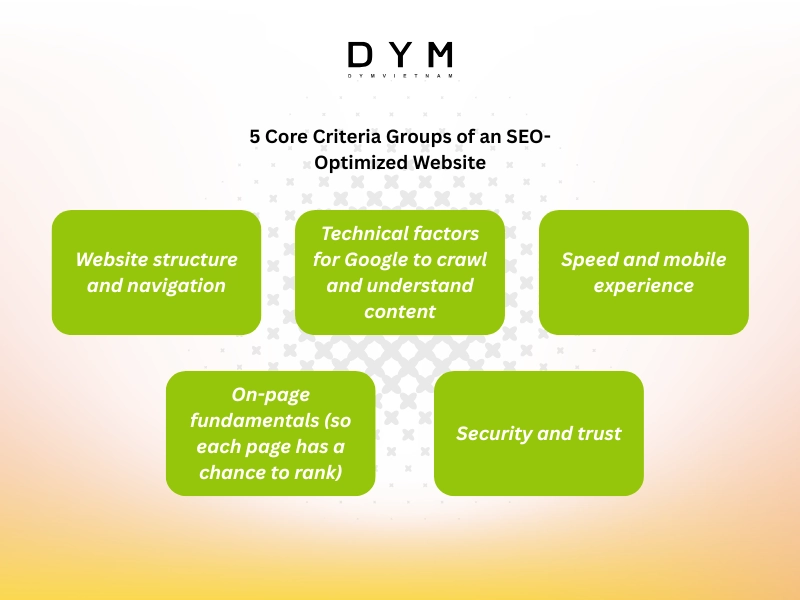
You don’t need to remember dozens of scattered checklists. Just stick to the five groups below and you’ll have the right foundation.
1) Website structure and navigation
An SEO-optimized website needs a clear hierarchy and helps users find the right information quickly:
- Clear, simple menu that prioritizes key pages (services/products/about/contact)
- Breadcrumb navigation if the website has multiple content layers
- Clean and consistent URLs (avoid long URLs and special characters)
- Logical internal linking: related articles lead to service/product pages, avoid random or excessive linking
Why is it important? A clear structure helps Google understand what your website is about, while also keeping users engaged longer and improving conversion rates.
2) Technical factors for Google to crawl and understand content
This is a “must-have” condition for a website to have a good chance of being properly indexed:
- Having sitemap.xml and robots.txt properly configured
- Correctly handling 301 redirects when changing URLs (to avoid traffic loss)
- Minimizing 404 errors and avoiding the creation of “thin” or unnecessary pages
- Using canonical tags when there is a risk of duplicate content
- Implementing basic schema (schema.org) for business/services/products/FAQ where appropriate
3) Speed and mobile experience
Most users access websites via mobile devices, so your site needs to:
- Use a mobile-first design, with a clean layout, readable text, and easy-to-tap buttons
- Optimize images and page resources (avoid heavy files and unnecessary loading)
- Have stable hosting/server performance, minimizing downtime
- Deliver a smooth user experience (related to Core Web Vitals)
Speed directly impacts CVR: the slower the page, the higher the bounce rate and the lower the number of leads/orders.
4) On-page fundamentals (so each page has a chance to rank)
A standard SEO page template typically includes:
- Title and meta description that clearly reflect the topic, avoiding duplication across key pages
- Proper heading structure (H1–H2–H3), like a well-organized article
- Content that matches search intent (informational/comparison/purchase)
- Images with appropriate alt text
- Clear CTAs: call, message, sign up, request a quote, purchase, etc.
Good on-page SEO helps Google understand the content and enables users to make decisions more quickly.
5) Security and trust
Both SEO and conversions require “trust.” A website should have:
- HTTPS/SSL (mandatory)
- Form spam protection and clearly defined admin permissions
- Transparent pages: About, Contact, and Policies (privacy/returns/terms)
- Clear business information (address, hotline, email, working hours if applicable)
Liên hệ DYM VIETNAM ngay! Contact DYM VIETNAM here!
How to quickly check if a website is SEO-optimized
You can self-evaluate in 3 steps, each taking only a few minutes.
Step 1: Check if the website is easy for Google to understand and index
- Does the website have a clear structure (menu, categories, service/product pages)?
- Are there many 404 error pages (try clicking a few old links or menu links)?
- When searching on Google using site:tenmien.com, do important pages appear?
If the site shows little to no results, or too many low-quality pages, you should review its indexing capability (this is a sign that the foundation is not yet solid).
Step 2: Check speed and mobile experience
- Open the page using 4G/5G: does it load quickly?
- Does the layout shift while loading?
- Are call/message/sign-up buttons easy to tap?
If you notice slow loading or hard-to-use text/buttons, then even if SEO rankings improve, conversions will still be difficult.
Step 3: Check basic on-page elements on a few key pages
Choose 1 service (or product) page and 1 blog post:
- Does the page title clearly reflect the main content?
- Is the layout easy to read (with sections and subheadings)?
- Is there a clear CTA (book now, request a quote, call now, etc.)?
- Does the content actually answer user questions, or is it too generic?
If key pages don’t address user needs effectively, you’ll likely see low CTR, low CVR, and higher CPA when running ads.
FAQ – Frequently Asked Questions about SEO-Optimized Website Design
1) Will an SEO-optimized website rank at the top immediately?
Not necessarily. An SEO-optimized website provides a strong foundation that helps Google better understand your site. To achieve top rankings, you still need content that matches search intent and continuous optimization based on data (typically from 30–90 days or more, depending on the industry).
2) Do you need advanced technical knowledge to build an SEO-optimized website?
Not necessarily, if you’re working with a technical team or an implementation partner that has a clear acceptance and QA process. You only need to understand the 5 core criteria groups and know how to perform quick checks as outlined above.
3) Is WordPress more “SEO-friendly” than other platforms?
WordPress has advantages in content management and its supporting ecosystem. However, being “SEO-friendly” still depends on the template, site speed, website structure, and how the content is managed and optimized.
4) Do you still need to do SEO after the website is finished?
Definitely yes. Completing the website only means the foundation is done. SEO growth requires topic-clustered content, ongoing on-page optimization, and continuous tracking using tools like Google Search Console and GA4 to improve over time.
SEO – SEM Services at DYM VIETNAM
With over 10 years of experience in SEO, DYM VIETNAM provides comprehensive SEO & SEM services, including:
- Consulting on SEO/SEM strategies tailored to each industry
- Implementing international-standard On-page & Off-page SEO
- Optimizing conversions (CRO) and improving ROI for businesses
- Data analysis, performance measurement, and periodic reporting
If you want a structured approach to ensure your website is both SEO-optimized and consistently generates leads/orders, DYM VIETNAM can support you end-to-end—from technical audit, speed optimization, and site structure standardization to on-page optimization, content planning, and performance tracking. Instead of figuring things out on your own and fixing issues one by one, you’ll have a clear roadmap with the right priorities to achieve results faster. Contact DYM VIETNAM for a quick consultation and tailored optimization recommendations specific to your industry.
Conclusion
SEO-optimized web design is not about a few isolated tricks, but a solid foundation that includes proper technical setup, clear on-page structure, good speed, and high trustworthiness. Once your website meets the five core criteria groups and you know how to perform quick checks, content creation and SEO efforts will become much easier, while conversion performance will also improve significantly.
DYM VIETNAM’s “ SEO Services” page here.


Mục Lục Table of content
- 1) Website structure and navigation
- 2) Technical factors for Google to crawl and understand content
- 3) Speed and mobile experience
- 4) On-page fundamentals (so each page has a chance to rank)
- 5) Security and trust