Messenger


SEO strategy for businesses: How to build and implement it effectively.
SEO is a crucial component of digital marketing strategy, enabling businesses to reach customers through organic search demand. However, to achieve tangible results, companies must adopt a strategic approach aligned with marketing and business objectives, rather than focusing solely on keyword rankings.
What Is an SEO Strategy and Why It Matters for Businesses

I-1. The Role of SEO in Digital Marketing
SEO is a channel that enables businesses to reach users at the moment they actively search for information on Google. Within the digital marketing ecosystem, SEO typically supports long-term growth while optimizing cost efficiency.
For businesses, SEO delivers key benefits:
- Reaching the right audience with real demand
- Reducing dependence on paid advertising
- Enhancing brand credibility and trust
- Supporting analysis and measurement of user behavior through search data
I-2. When Should Businesses Implement SEO?
SEO is well-suited for businesses with a long-term growth vision and a goal of building a sustainable customer acquisition channel. It should typically be implemented once the website has a solid foundational structure and there is clear search demand for the company’s products or services on Google.
SEO is particularly effective for businesses looking to optimize marketing costs while continuously increasing the value of their website content over time.
Key Components of an SEO Strategy
II-1. Keyword Research Aligned with Business Objectives
Keyword research is a foundational step in any SEO strategy, helping businesses accurately identify customer search intent. Keyword selection should be aligned with business objectives rather than focusing solely on search volume.
SEO keywords are typically categorized into:
- Informational keywords
- Comparison and consideration keywords
- Conversion-driven keywords
This approach ensures SEO content aligns with the customer journey and delivers meaningful business value.
II-2. SEO Content and the Role of Content
Content is a core factor that determines SEO effectiveness. Google prioritizes content that accurately addresses search intent and provides valuable information to users.
Within an SEO strategy, content is typically developed in the following formats:
- Pillar content
- Supporting articles for specific subtopics
- Evergreen content
High-quality SEO content not only improves search rankings but also helps build brand credibility and trust.
II-3. How Technical SEO Impacts Performance
Technical SEO enables search engines to better understand and evaluate a website. Without a solid technical foundation, SEO content will struggle to perform effectively.
Key technical factors include:
- Page loading speed
- Mobile responsiveness
- URL structure and indexability
Technical SEO serves as the foundation of the entire SEO strategy.
II-4. SEO and User Experience (UX)
User experience is increasingly prioritized by Google in SEO. A well-designed UX makes it easier for users to access information and enhances engagement.
SEO and UX are closely connected through:
- Time on page
- Bounce rate
- Content engagement
Optimizing UX helps ensure more sustainable SEO performance in the long term.
Liên hệ DYM VIETNAM ngay! Contact DYM VIETNAM here!
How to Build an SEO Strategy in Practice

III-1. Defining SEO Goals and KPIs
SEO should be implemented with clear objectives to enable effective performance measurement. Businesses should not evaluate SEO based solely on traffic, but also consider the quality of that traffic.
Common SEO KPIs include:
- Organic traffic
- Keyword rankings
- Conversion rate from organic traffic
- User behavior on the website
III-2. Developing an SEO Content Plan
An SEO content plan helps businesses produce content systematically and avoid topic duplication. Content is typically planned on a monthly basis or organized by keyword clusters.
An effective SEO content plan should ensure:
- Comprehensive coverage of core topics
- Internal linking between articles
- Alignment with overall marketing objectives
III-3. Integrating SEO with Other Marketing Channels
SEO does not operate in isolation; it should be integrated with other digital marketing channels to maximize effectiveness.
Combining SEO with channels such as search advertising, social media, and email marketing helps to:
- Leverage data across channels
- Enhance content performance
- Optimize marketing costs
Common Mistakes in SEO

IV-1. Over-Focusing on Keywords
Keyword stuffing or focusing solely on rankings can reduce content quality and user experience, ultimately having a negative impact on SEO performance.
IV-2. Implementing SEO Without Measuring Performance
SEO requires continuous monitoring and optimization. Without data-driven measurement, businesses will struggle to accurately evaluate performance and make timely strategic adjustments.
SEO Services at DYM VN
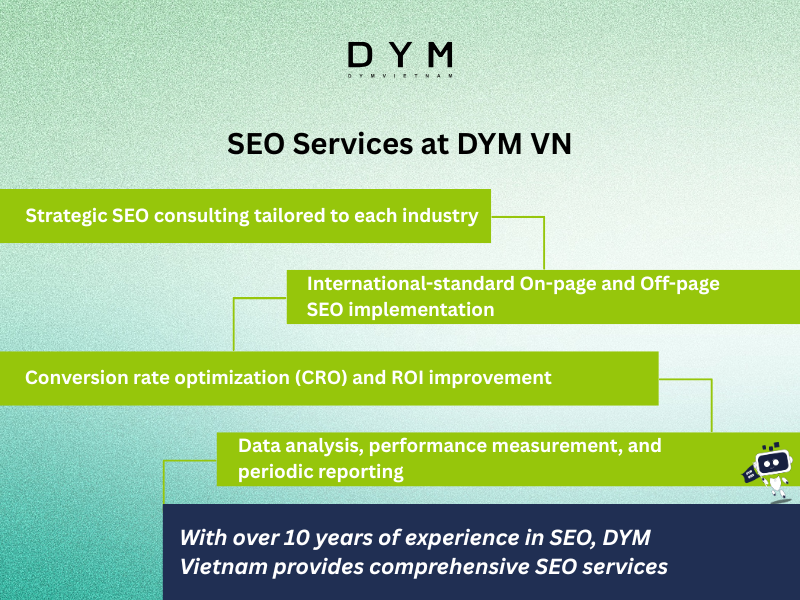
With over 10 years of experience in SEO, DYM Vietnam provides comprehensive SEO services, including:
- Strategic SEO consulting tailored to each industry
- International-standard On-page and Off-page SEO implementation
- Conversion rate optimization (CRO) and ROI improvement
- Data analysis, performance measurement, and periodic reporting
We believe that SEO not only improves search rankings but also serves as a key driver for expanding brand presence and revenue growth for Vietnamese businesses in the digital landscape.
Conclusion
SEO should be implemented with a clear strategy aligned with marketing and business objectives. When executed effectively, SEO becomes a sustainable growth channel that delivers long-term value for businesses.
DYM VIETNAM’s “ SEO Services” page here.


Mục Lục Table of content
- II-1. Keyword Research Aligned with Business Objectives
- II-2. SEO Content and the Role of Content
- II-3. How Technical SEO Impacts Performance
- II-4. SEO and User Experience (UX)