Messenger


Case Study: AI SEO for eCommerce — Driving Traffic & Revenue Growth Through an AI-Powered SEO Strategy
In the highly competitive eCommerce landscape, where brands are constantly battling on pricing, product offerings, and advertising performance, SEO has long been considered a sustainable growth channel. However, as search behavior evolves and digital content continues to explode in volume, traditional SEO strategies are rapidly losing their effectiveness if they fail to adapt.
This is where AI SEO emerges as a game-changing advantage.
By integrating AI into SEO operations, eCommerce businesses can go beyond simply increasing website traffic — they can drive meaningful revenue growth, improve conversion performance, and scale their organic presence more efficiently than ever before.
In this case study, we’ll explore how an eCommerce brand successfully restructured its SEO ecosystem using AI-driven strategies, resulting in significant improvements in organic traffic, search visibility, and overall business performance.
The Challenge: Traffic Without Conversions
The business featured in this case study operated an eCommerce website with a diverse product portfolio. Despite investing heavily in both SEO and paid advertising over an extended period, the brand continued to face several critical challenges:
- Organic traffic growth remained slow and heavily dependent on paid ads
- Product pages struggled to achieve top search rankings
- Blog content generated visibility but failed to drive meaningful conversions
- Conversion rates remained low, with users visiting the site but leaving without taking action
What stood out most was this: SEO efforts were generating activity — but not contributing to actual revenue growth.
The Core Problem: SEO Was Disconnected from the Customer Buying Journey
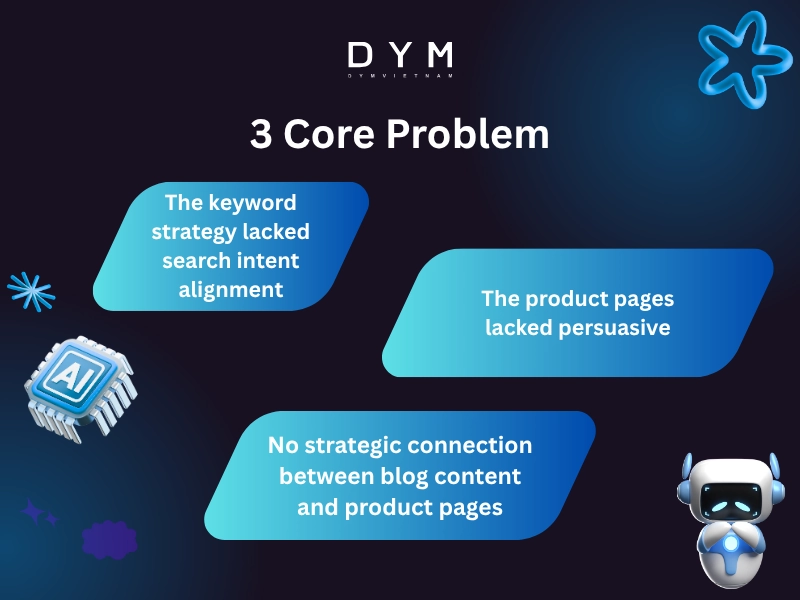
Further analysis revealed three key issues:
First, the keyword strategy lacked search intent alignment:
The SEO content primarily targeted broad, highly competitive keywords such as “fashionable shoes” or “stylish clothing,” but failed to address specific user needs and purchase-driven searches like “running shoes for beginners” or “easy-to-style office shirts.”
Second, the product pages lacked persuasive, conversion-focused content:
While the pages were technically optimized with titles and meta descriptions, they offered little information that could genuinely help users make purchasing decisions. The experience was optimized for search engines — not for buyers.
Third, there was no strategic connection between blog content and product pages:
Although the website invested in content marketing, blog articles were not effectively guiding readers toward relevant products or purchase actions. As a result, potential customers entered the ecosystem but were never nurtured through the buying journey.
In other words, the SEO strategy was disconnected from the sales funnel.
Liên hệ DYM VIETNAM ngay! Contact DYM VIETNAM here!
Strategic Objectives
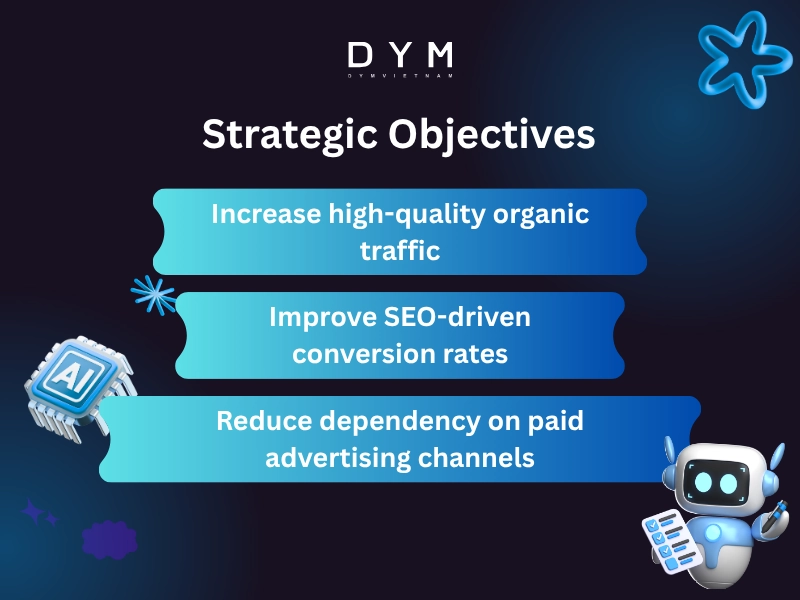
The business established three clear strategic goals:
- Increase high-quality organic traffic
- Improve SEO-driven conversion rates
- Reduce dependency on paid advertising channels
Most importantly, the company redefined the role of SEO within its growth strategy.
AI SEO Strategy Implementation
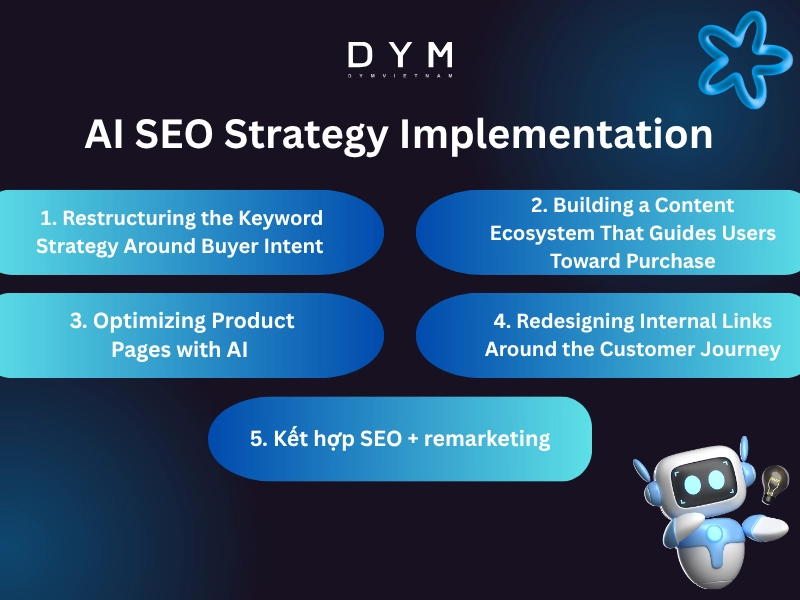
Restructuring the Keyword Strategy Around Buyer Intent
Instead of chasing high search volume alone, the entire keyword strategy was rebuilt based on customer search intent and buying behavior.
Keywords were categorized according to different stages of the purchasing journey:
- Awareness stage: “What are running shoes?”
- Consideration stage: “Running shoes vs training shoes”
- Decision stage: “Best running shoes for beginners”
- Purchase stage: “Affordable authentic running shoes”
AI played a critical role throughout this process by helping the team:
- Analyze search behavior patterns
- Identify high-potential long-tail keywords
- Detect specific customer needs and purchase intent
As a result, the SEO strategy shifted away from vanity traffic metrics and focused instead on keywords with strong conversion potential.
Building a Content Ecosystem That Guides Users Toward Purchase
Rather than publishing disconnected blog articles, the company restructured its content strategy around the customer funnel:
- Top of Funnel (TOFU): Educational and awareness-driven content
- Middle of Funnel (MOFU): Comparison articles and product reviews
- Bottom of Funnel (BOFU): Product selection guides and purchase-oriented content
For example:
- “How to Choose Running Shoes for Beginners”
→ Strategically linked to relevant product categories
→ Featured recommended products tailored to user needs
This transformed content from a simple informational asset into a powerful sales-driving tool.
Optimizing Product Pages with AI
One of the most significant transformations came from redesigning and optimizing the product page experience.
AI was strategically implemented to:
- Rewrite product descriptions based on user search intent
- Add FAQ sections addressing common customer concerns
- Recommend comparison-driven content to support decision-making
- Enhance semantic keyword optimization for stronger search relevance
As a result, product pages evolved from simple browsing destinations into high-converting decision-making assets.
Redesigning Internal Links Around the Customer Journey
The internal linking structure was completely rebuilt to align with the buying funnel:
- Blog articles → linked to relevant product categories
- Category pages → guided users toward specific products
- Product pages → connected to educational and buying-guide content
Users always have a clear next step, “preventing interruptions” in the customer journey.
Combining SEO + Remarketing
SEO helps drive traffic, but not all visitors make a purchase immediately.
Therefore, the system is integrated with remarketing strategies:
- Blog readers → retargeted with ads
- Product viewers → reminded through advertising campaigns
Increasing conversion opportunities from SEO traffic
Results After 4 Months of Implementation
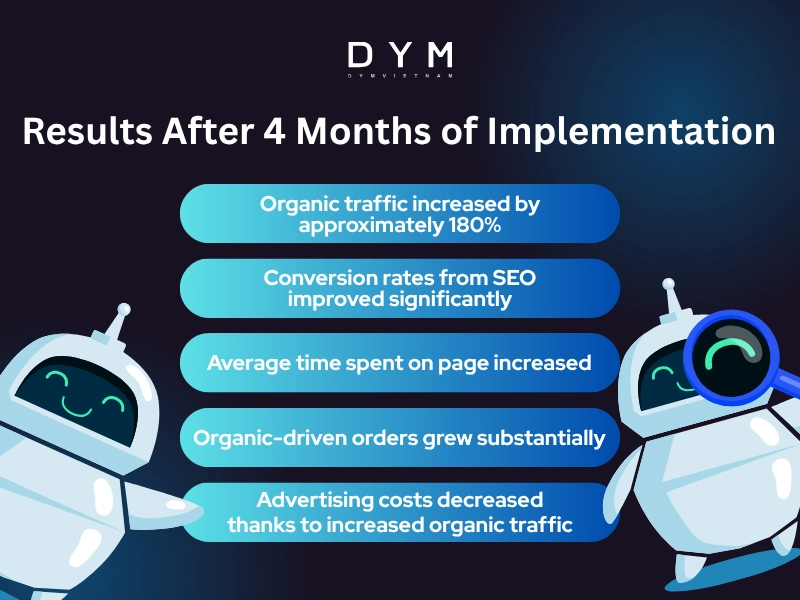
After applying the AI SEO strategy:
- Organic traffic increased by approximately 180%
- Conversion rates from SEO improved significantly
- Average time spent on page increased
- Organic-driven orders grew substantially
- Advertising costs decreased thanks to increased organic traffic
Most importantly, SEO began generating actual revenue.
Strategic Lessons for eCommerce
SEO Must Be Tied to Revenue
Traffic has no value if it does not convert.
Content Must Drive Action
Every piece of content should play a role within the funnel.
Product Pages Are the “Most Important SEO Pages”
It is not only about technical optimization, but also about optimizing purchasing decisions.
AI Helps Scale, but Strategy Determines Results
AI is only effective when positioned correctly within the overall system.
AI SEO Implementation Solutions for eCommerce
In practice, implementing AI SEO effectively for eCommerce requires the integration of multiple elements:
- SEO
- Content
- Advertising
- Data
Without hands-on experience, self-implementation can be challenging.
DYM Vietnam – AI SEO & Advertising Solutions for eCommerce
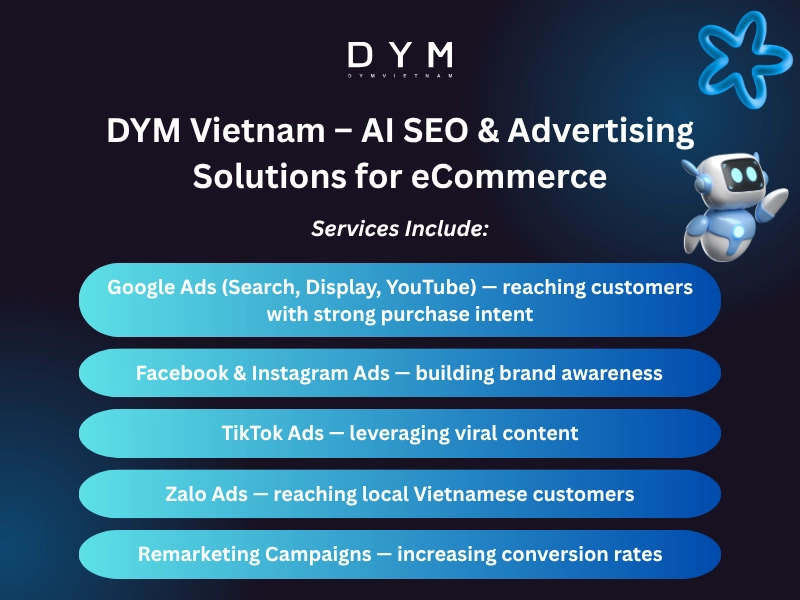
With more than 10 years of experience in the Japanese market, DYM Vietnam provides multi-channel marketing solutions that help eCommerce businesses maximize growth.
Services Include
- Google Ads (Search, Display, YouTube) — reaching customers with strong purchase intent
- Facebook & Instagram Ads — building brand awareness
- TikTok Ads — leveraging viral content
- Zalo Ads — reaching local Vietnamese customers
- Remarketing Campaigns — increasing conversion rates
Key Advantages
- Personalized strategies tailored to each industry
- Integration of SEO + Ads + Content
- Transparent reporting with clear performance measurement
- Budget and ROI optimization
This foundation enables businesses not only to increase traffic, but also to effectively leverage LLMO (Large Language Model Optimization), improving visibility across AI-powered platforms.
Conclusion
In eCommerce, AI SEO does not simply help you rank higher — it helps you sell more products.
The right combination of AI, SEO, and content strategy creates a sustainable growth system that reduces dependence on paid advertising while strengthening competitive advantage.
In the future, businesses that adopt AI SEO early will gain a significant advantage not only on Google, but across the entire next-generation search ecosystem.
DYM VIETNAM’s “ SEO Services” page here.


Mục Lục Table of content
- Restructuring the Keyword Strategy Around Buyer Intent
- Building a Content Ecosystem That Guides Users Toward Purchase
- Optimizing Product Pages with AI
- Redesigning Internal Links Around the Customer Journey
- Combining SEO + Remarketing