Messenger


Advertising Analysis: A Technical Process for Optimizing Marketing Campaign Performance
In Digital Marketing, launching an advertising campaign is only the first step. To ensure that a campaign delivers meaningful results, businesses need to regularly analyze advertising performance based on actual data. This process helps marketers understand how their ads are performing, identify what is working, determine what needs to be optimized, and decide how the budget should be allocated.
Advertising analysis goes beyond simply checking whether an ad has received a high number of clicks. A campaign should be evaluated comprehensively using multiple metrics such as CTR, CPC, CPM, CPA, CVR, ROAS, Frequency, Reach, Impressions, and conversion quality.
What Is Advertising Analysis?
Advertising analysis is the process of collecting, interpreting, and evaluating data from advertising campaigns to determine both communication performance and business performance.
The objectives of advertising analysis include:
- Evaluating campaign performance
- Identifying the causes of rising costs or declining conversions
- Identifying effective audiences, content, and advertising channels
- Optimizing advertising budgets
- Improving results in subsequent campaign periods
In practice, advertising analysis should combine quantitative data with qualitative evaluations of advertising content.

Key Metrics for Advertising Analysis
Impressions and Reach
Impressions refer to the number of times an advertisement is displayed, while Reach refers to the number of unique users who have seen the advertisement.
If Impressions are high but Reach remains low, this may indicate that the advertisement is being shown repeatedly to the same group of users. In this case, marketers should check the Frequency metric to avoid ad saturation.
Frequency
Frequency indicates the average number of times each user has seen an advertisement.
If Frequency increases while CTR decreases, the audience may be experiencing ad fatigue from the current content. This can be a sign that the business needs to refresh its creative, expand the target audience, or adjust the ad delivery schedule.
CTR
CTR is the percentage of users who click on an advertisement after seeing it.
A low CTR may indicate:
- The content is not engaging enough
- The message does not match customer needs
- The image or video is not attractive enough
- The targeting is not accurate
CTR is an important metric for evaluating how appealing an advertisement is at the top of the marketing funnel.
CPC
CPC refers to the cost per click.
When CPC increases, marketers should examine CTR, CPM, and audience quality together. CPC can increase because the advertisement is less engaging, competition has become stronger, or the target audience is too narrow.
CPM
CPM refers to the cost per 1,000 impressions.
An increase in CPM can be caused by:
- Higher competition in ad auctions
- A small target audience
- Highly competitive industries
- Peak advertising periods
- Low ad quality
When CPM increases but CTR remains strong, the issue may be related to market conditions or bidding. If both CPM increases and CTR decreases, the creative and targeting should be reviewed.
CVR
CVR is the conversion rate after users click on an advertisement.
If CTR is high but CVR is low, this indicates that the advertisement is successful in attracting users but fails to generate the desired action. Possible reasons include:
- An under-optimized landing page
- Inconsistent messaging between the advertisement and landing page
- A registration form that is too complicated
- An unattractive price or offer
- Low-quality traffic
CPA
CPA refers to the cost per conversion.
It is one of the most important metrics for performance marketing campaigns. CPA can increase when CPC rises, CVR decreases, or both occur simultaneously.
When analyzing CPA, marketers should not look at this metric in isolation. Instead, they should evaluate the entire customer journey from impression and click through to conversion.
ROAS
ROAS refers to the return on advertising spend.
When the primary campaign objective is sales, ROAS helps businesses evaluate whether their advertising investment is generating sufficient revenue. A campaign may generate many orders but still be inefficient if its advertising costs are too high and ROAS remains low.

Liên hệ DYM VIETNAM ngay! Contact DYM VIETNAM here!
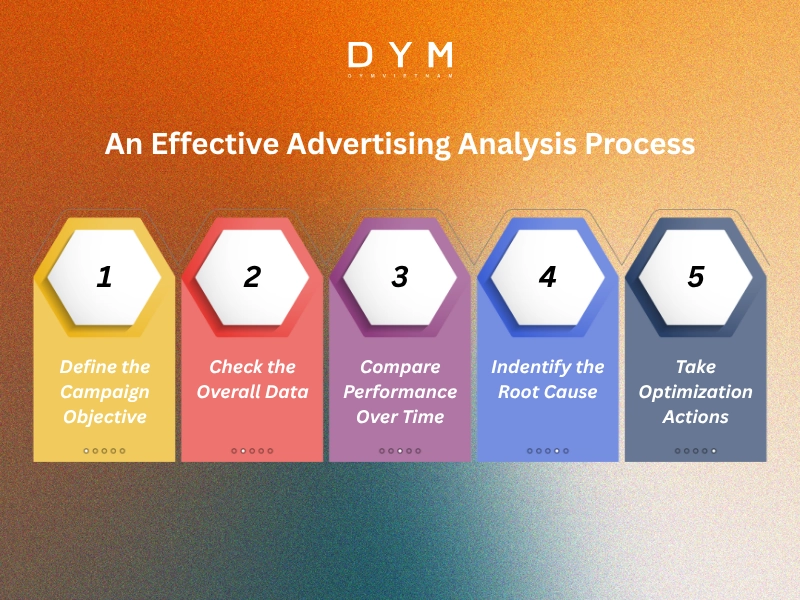
An Effective Advertising Analysis Process
Step 1: Define the Campaign Objective
Before analyzing performance, marketers need to understand the campaign’s original objective.
For example:
- Awareness: Prioritize Reach, Impressions, Frequency, and Video Views
- Traffic: Prioritize Clicks, CTR, and CPC
- Lead Generation: Prioritize CVR, CPL, and CPA
- Sales: Prioritize Purchases, CPA, and ROAS
Without clearly defining the objective, advertising performance can easily be evaluated incorrectly.
Step 2: Check the Overall Data
Marketers should review key metrics across different levels:
- Campaign
- Ad Set
- Ad
- Creative
- Audience
- Placement
- Device
- Time
Analyzing data at each level helps identify exactly where the problem occurs.
For example, if CPA increases across the entire campaign, marketers should identify which ad set is negatively affecting performance. If only one creative has a low CTR, the problem may be related to the advertising content.
Step 3: Compare Performance Over Time
Advertising performance should not be analyzed based on a single day of data.
Businesses should compare performance across:
- The last 7 days
- The last 14 days
- The last 30 days
- Previous comparable periods
Comparing data over time helps identify performance trends more clearly.
Step 4: Identify the Root Cause
After identifying a problem, marketers need to determine its underlying cause.
For example, if CPA increases, the analysis can follow this logic:
Did CPA increase because CPC increased or because CVR decreased?
If CPC increased:
- Did CTR decrease?
- Did CPM increase?
- Is the creative experiencing fatigue?
If CVR decreased:
- Is there an issue with the landing page?
- Is the traffic reaching the right audience?
- Is the offer still attractive?
This approach helps marketers avoid making conclusions based on assumptions or intuition alone.
Step 5: Take Optimization Actions
After identifying the root cause, marketers should propose specific optimization actions.
Common optimization approaches include:
- Refreshing creatives
- Testing additional content angles
- Expanding or refining the target audience
- Adjusting the advertising budget
- Optimizing the landing page
- Testing different placements
- Optimizing CTAs
- Running remarketing campaigns for users who have already engaged
Each action should be connected to a clear hypothesis so that its impact can be measured effectively.
Common Mistakes in Advertising Analysis
Looking at Only One Metric
A common mistake is to look only at CTR or CPC and then conclude that an advertisement is performing well or poorly.
In reality, an advertisement with a high CTR but high CPA may still be inefficient. Conversely, an advertisement with a lower CTR but higher-quality conversions may still be worth keeping.
Evaluating Performance Too Early
Advertising data needs to reach a sufficient volume before reliable conclusions can be drawn. If the analysis is based on only a few hundred impressions or several clicks, the results may not yet be statistically meaningful.
Failing to Distinguish Creative and Landing Page Issues
If CTR is low, the issue is often related to the creative or targeting.
If CTR is high but CVR is low, the issue is more likely related to the landing page, offer, or traffic quality.
Correctly identifying the bottleneck allows businesses to optimize campaigns more quickly and accurately.
Failing to Monitor Long-Term Trends
A campaign may perform well during the first few days but gradually lose effectiveness due to creative fatigue or audience saturation. Therefore, marketers need to monitor performance trends rather than focusing only on results at a single point in time.

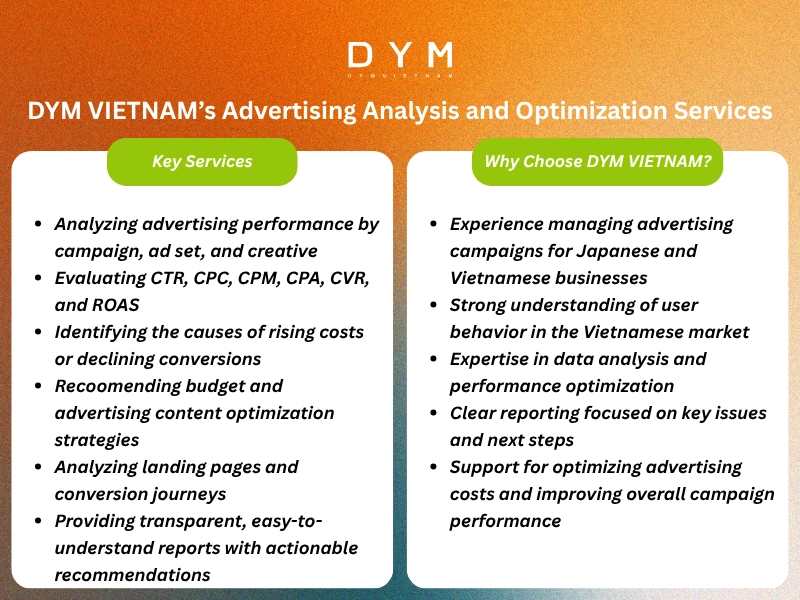
DYM VIETNAM’s Advertising Analysis and Optimization Services
Effective advertising analysis requires the ability to interpret data, understand advertising platforms, and develop appropriate optimization actions.
DYM VIETNAM provides solutions to help businesses analyze and optimize advertising campaigns across platforms such as Facebook, Google, TikTok, and YouTube.
Key Services
- Analyzing advertising performance by campaign, ad set, and creative
- Evaluating CTR, CPC, CPM, CPA, CVR, and ROAS
- Identifying the causes of rising costs or declining conversions
- Recommending budget and advertising content optimization strategies
- Analyzing landing pages and conversion journeys
- Providing transparent, easy-to-understand reports with actionable recommendations
Why Choose DYM VIETNAM?
- Experience managing advertising campaigns for Japanese and Vietnamese businesses
- Strong understanding of user behavior in the Vietnamese market
- Expertise in data analysis and performance optimization
- Clear reporting focused on key issues and next steps
- Support for optimizing advertising costs and improving overall campaign performance
Conclusion
Advertising analysis is an essential process that helps businesses not only understand how their campaigns are performing but also identify why results are improving or declining. When conducted properly, advertising analysis can help businesses optimize budgets, improve content, increase conversion rates, and enhance overall marketing performance.
As advertising costs become increasingly competitive, businesses should treat data analysis as an ongoing activity rather than something performed only when a campaign encounters problems. This is the foundation for making advertising campaigns more efficient, measurable, and sustainable.
DYM VIETNAM’s “Advertising Outsourcing Service” page here.


Mục Lục Table of content
- Step 1: Define the Campaign Objective
- Step 2: Check the Overall Data
- Step 3: Compare Performance Over Time
- Step 4: Identify the Root Cause
- Step 5: Take Optimization Actions